
Home › Forums › The Fiat Standard › Why is there not a single country in the world on a gold standard TODAY?
-
Why is there not a single country in the world on a gold standard TODAY?
Posted by Hendrik on March 30, 2023 at 04:30I realize governments prefer to print their own money. It gives them more control.
But if sound money is superior how is there not a single benevolent president or king or whoever who decided it would be best to 100% back their countries currency with gold after 1971?
Is it the fact that every other country would have to play along or what am I missing there?
There are 180 different currencies in the world you would think that at least one country would have attempted this.
Marek FIJALKOWSKI replied 1 week, 6 days ago 13 Members · 18 Replies -
18 Replies
-

That’s a really good question. I suspect the power to print is too alluring for most countries. Another thing that could be happening is the promise of free money. There may be a minority of benevolent leaders that would be willing to do this, but when the run up against someone promising something for nothing, the other party gets elected. Thus, rendering the benevolent leader worthless.
-

Thanks. The fact that a party who would promote this can not promise voters the same short term benefits as a party who can keep printing money is something I have overlooked. I suppose that would also go back to the fact that parties in a democracy are usually only elected for 4 years.
With that I now wonder if there are any parties in any country who have attempted this or who have come close..
-
-

I suspect this is where a monarchy would be superior, countering the 4 year election cycle of so-called democracies.
-

One of the reason i would argue is the fact that Gold is not held by one single nation only. Despite the fact that the US has the most but all other countries who also have gold reserve far exceeds US gold reserve if we add them together so my point is that it will be hard to determine the hegemony in this case and come up with a solution. That’s one of many reasons i would say. Thanks
-
Wouldn’t it give the country who starts to do this first a jump start?
Say Switzerland does this. They are the 7th biggest gold holder but only the 20th biggest economy worldwide. I don’t see how they wouldn’t benefit but someone smarter than me needs to chime in on this. I have tried to google a good answer but couldn’t find anything.
Here is a list of who holds the most gold and the west dominates the statistics
https://tradingeconomics.com/country-list/gold-reserves
(Pretty surprised to see Germany and Italy at 2 and 3 respectively.)
-
-
I think whoever starts first does not matter because you can start first but only have a small percentage of gold reserve which does give you any kind control. That’s my opinion at least.
Thanks
-
Lyn Alden discusses this in her book Broken Money (or in her interviews, for example Bankless this week)… My interpretation here.
Imagine there is a war.
The country that can print money out of thin air is able to finance the war effort by extracting all the wealth from its people.
The country on hard money standard (e.g. gold) can only finance the war effort via taxation (= coercition) and war bonds (= voluntarily). If the war is not popular (too far away, unjust, painful, etc), the people won’t buy the bonds. If taxation is too much, people will revolt.
So, weak money allows for total war. The country with weak money will win the war. So all countries will switch to weak money.
But even without war. It’s like a darwinist selection of moneys. 20th century is the moment when gold became uncompetitive because of the progress of telecommunications. Moving gold became too slow and expensive, and so people switched to weaker moneys (fiat), because that allowed to transfer the money electronically. The downside: centralization of the ledger (via banks, then central banks).
To get back to hard money, we need a money that imposes itself sneakily to the countries…
-

If your country is using gold instead of the reserve currency, your exports are not competitive. To buy your exports, people in other countries have to convert their currency to gold, which gets more expensive as their currencies lose value due to inflation.
-
politicians couldn’t make the promise of social programs if they had to pay for them with money backed by gold.
-

This seems to me to be a critical question that, until answered, hard money will never stick. The 2 main points:
1) A governing authority based on hard money will not be able to defend themselves from money printer entities and so will fail. So stability of a hard money world is is at risk from even a single money printer.
2) A governing authority based on hard money will not be able to offer immediate services (i.e. todays entitlements) to subjects that a money printer authority could offer. Consequently, the money printer will always win election over the hard money authority.
These are both short term issues that would, in the long run, cause failure of the money printer authority (perhaps a generational time frame). But, in general, people don’t think or act for the long term. The money printer authority always appears superior to the hard money authority in the near term.
So how can a hard money world ever be stable?
At this point, my only answer is through education and culture. If every hard money citizen is raised to understand the foundations of economic theory, the false promises of soft money, and this knowledge is embedded in the culture (intrinsic motivation), then the population as a whole would strongly resist soft money. I think the other requirement would be that such a culture must embody ideals of equity and constantly demonstrate the ability to maintain and improve living standards. And again, a culture that understands soft money is the antithesis of these ideals would be a requirement.
Am I off base here? What points have i missed and what alternatives are there to create a stable hard money world?
-
Interesting. I would also like to hear this conundrum resolved. Can a hard money standard survive the emergence of printable soft moneys? How?
-
-
Education and culture will let individuals choose the hard money, yes. (He who hoards first the new hard money becomes more powerful over time, and that’s how easy moneys get replaced by harder ones.)
But for countries, because it’s about masses of people, I guess stable adoption of harder moneys will be about game theory dynamics?
Clearly the fiat (dollar) standard won over the gold standard, so far.
The next money will need be harder than dollar.
Imagine a small country hoarding bitcoin early, getting wealthier, then others follow, profiting most the earlier they join.
Some day that small but wealthly country on bitcoin standard feels threatened, needs stronger military capabilities and alliances.
Either it start printing fiat money. Or it makes alliances with other countries bitcoin standard? Or whatever else.
And the superior money will win: maybe bitcoin, maybe dollar, mayber others.
It won’t be one country alone on hard money standard. Because if that money standard is superior, others will follow. If it isn’t, this first adopter will finally abandon it.
It will be all countries moving progressively to the new superior money standard.
No country is on gold standard nowadays, because gold isn’t the hardest money anymore. (By definition of “hard money”).
For memory, the attributes of hard money:
– salability across scales (divisible, fungible),
– salability accross space (transportable, easy to authenticate, check purity, acceptability)
– salability accros time (low inflation, limited and predictable supply, doesn’t rot or corrode, no central authority)
-
thanks Jerome for contributing…..
“Education and culture will let individuals choose the hard money, yes. (He who hoards first the new hard money becomes more powerful over time, and that’s how easy moneys get replaced by harder ones.)”
- some people are willing and able to accept education about hard money some are not (willing or able)
- the question is: how to approach all types and bring them on board?
“But for countries, because it’s about masses of people, I guess stable adoption of harder moneys will be about game theory dynamics?:”
- a game theory approach: probably needs an entire new thread
- one theory is that a hard money world might be mostly borderless
- how to apply game theory to attaining and keeping a hard money world?
“Clearly the fiat (dollar) standard won over the gold standard, so far.
The next money will need be harder than dollar.”
- the dollar is fiat and by definition soft and inferior. gold, harder and superior, lost to fiat but only in the short run. fiat is now imploding…again
- at the core of why gold failed is it’s centralized nature. since gold is not portable we must have, at least somewhat, centralized control of gold where that authority issues portable gold notes. this centralization eventually leads to abuse and migration to notes not linked to the underlying asset (gold), in other words, fiat.
- bitcoin is harder than gold by being portable and decentralized but is it vulnerable to fiat in other ways?
“Imagine a small country hoarding bitcoin early, getting wealthier, then others follow, profiting most the earlier they join.
Some day that small but wealthly country on bitcoin standard feels threatened, needs stronger military capabilities and alliances.
Either it start printing fiat money. Or it makes alliances with other countries bitcoin standard? Or whatever else.
And the superior money will win: maybe bitcoin, maybe dollar, mayber others.
It won’t be one country alone on hard money standard. Because if that money standard is superior, others will follow. If it isn’t, this first adopter will finally abandon it.
It will be all countries moving progressively to the new superior money standard.”
- so far the superior money hasn’t won. that’s why we’re in this pickle
- is the message here that hard money will never win unless the world is dominated by hard money?
“No country is on gold standard nowadays, because gold isn’t the hardest money anymore. (By definition of “hard money”).”
- the reason we’re not on the gold standard is not because gold isn’t the hardest money (up until bitcoin gold has been the hardest money). it’s because gold has two flaws: 1) it’s not portable and 2) therefore has to be centralized. these points make gold vulnerable to corruption and migration to fiat is the result. but bitcoin (and the blockchain) fixes these points. so bitcoin is the hardest money ever, but it still may not win.
Conclusion?
the point of all this, so far, i think, is that to enable a stable hard money world:
- a hard money world is not inherently stable?
- we need to figure out how to gain (and keep) acceptance of all people types of the perils of soft money and the virtues of hard money?
- and we need hard money to dominate?
-
In my opinion, I think countries/governments do not want to be on a gold standard because it would take power and influence from the government. When you have control of the money supply, governments are able to make a lot of mistakes without being accountable for as they can always print themselves out debt (monetizing the debt). When you monetize the debt, you penalize savers.
If you could not print money on demand, you will be more cautious managing your budget. There wouldn’t be bailouts or there would be a lot less bailouts. Additionally, politicians just want to stay in power for as long as possible and the only way they can do that is by promising a lot of things that can only be achieved by using social programs, which are financed by the government. For example, the US has a fiscal deficit, but we still need to fund healthcare programs, food stamps, military, etc. This can only be financed by issuing bonds, which are bought by the FED using newly created money, increasing inflation and keeping people poor.
If anyone had the money machine in their power, no one would ever let that go.
-
Hello everyone, I am new to the forum but a long time Bitcoiner and fan of Saif.
My question is related but about economic growth. Is not so much of the modern growth of companies, and the innovation cycles, funded by fiat credit creation? In a hard money world, will this mean that the reduced credit available to entrepreneurs will result in less innovation and technological development? Many entrepreneurs already go from Europe to the US to raise capital, and we know that most capital is based on fiat credit creation?
In other words, could a Bitcoin/Gold Standard monetary base result in lower economic growth?
(I realise that I have not properly taken account of Jeff Booth’s tech deflation arguments, but in the wor,d where innovations inevitably fall to the marginal cost of production why WOULD you risk your capital for the inevitably low returns on offer? Does it not lead to technological stagnation in the same manner they do in Communist systems?
Interested to hear your views. Thank you.
-
it is written in saif’s work somewhere :
England tried to go back to a gold standard in the early 20th century
and america abandonned it for the same reason in 71
The reason is other countries would have an advantage over the ones with gold standard.FOREIGN COUNTRIES Accumulated a lot of english and american currency when they were gold collateralized and drained their reserves as other countries would redeem them for gold.
-
https://x.com/BitcoinNewsCom/status/2105378063005479401?s=20
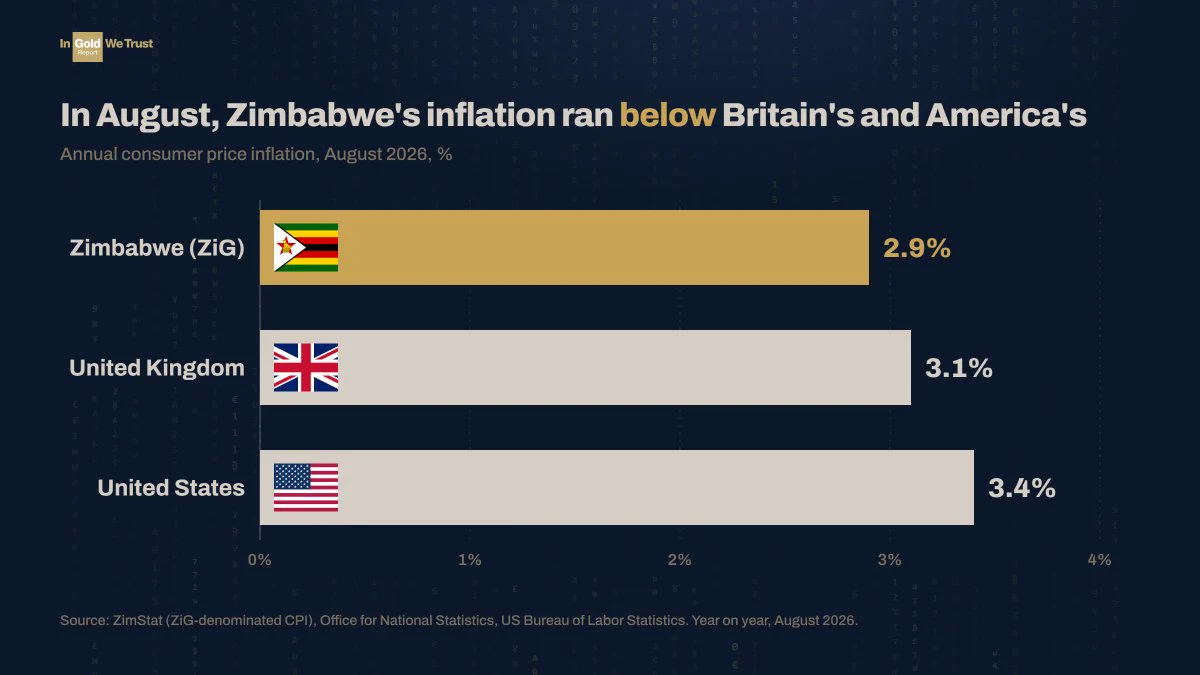
There is one apparently
Zimbabwe since 2024x.com
Bitcoin News (@BitcoinNewsCom) on X
🇿🇼 ZIMBABWE’S INFLATION FALLS BELOW 🇺🇸 US AND 🇬🇧 UK AFTER ADOPTING HARD MONEY Zimbabwe’s annual inflation fell to 2.9% in August, below the UK at 3.1% and the US at 3.4%. The milestone is mind-blowing for a country synonymous … Continue reading
Log in to reply.